Friday, April 30, 2010

Poetry & Rhyming

Rhyming is a fairly easy concept for preschoolers to understand. And so many kids' books rhyme, so often when I'm reading a book where the rhyme is obvious, I'll pause to let the kids guess the rhyming word in the story. Not long, just a little bit to allow the kids that are paying attention to shout out the missing word. Alliteration is also simple for kids to grasp - words that start with the same sound. Since April is National Poetry Month, I thought we'd talk a little about rhymes and alliteration for this week's storytime.

Book 1: Sheep in a Jeep by Nancy Shaw
Of the thousands of books in rhyme for kids, I wanted to pick a couple whose main emphasis was on rhyming. Sheep in a Jeep is perfect. The story is secondary (though funny) - the point of the book is that most of the words end in "-eep". I though about (though decided against) also doing the board book "Truck Duck" by Michael Rex.


Book 2: One Fish, Two Fish, Red Fish, Blue Fish by Dr. Seuss
Classic Dr. Seuss book. Wonderful rhymes, and plenty of alliteration too. What more can I say?


Book 3: Berenstain's B Book by Stan & Jan Berenstain
For our final "poetry" book, we talked about alliteration. The kids already (mostly) knew what it was, they just didn't know the word for it. But we practiced saying "alliteration" a few times, then read the "B Book". Afterwards, we thought of other words that started with B. 


Activity: I was a slacker this week and just made a worksheet for this week's activity. Had pictures on one side of a hat, bear, etc. and had cat, hair, etc. on the other side. They were to connect the two pictures that rhymed.
Theme used week of April 26th, 2010. Next week: Mother's Day!

Monday, April 5, 2010

Rainbows

We talked about colors this week, and I started off by having everyone name their favorite color.  The library had purchased a couple of very neat books about color that I was so excited to read to the kids, and this was my opportunity.

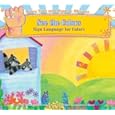
Book 1: See the Colors by Dawn Babb Prochovnic
This book has a nice, calm phrasing that repeats the name of different colors on each page. "See the blue, see the blue, see the blue, little one. Chase the blue jays from our garden, see the blue, little one." What's neat is that it shows the word in sign language on each page (with more detailed instructions on how to do them in back). I signed and also had the kids signing the different colors on each page. At the end, I had a little "quiz" and it's amazing how many kids retained most or all of the signs by the end.

Book 2: The Black Book of Colors by Menena Cottin and Rosana Faria
Most of the kids had some knowledge of sign language and how deaf people used it to communicate. But then I brought out The Black Book of Colors and we talked about how blind people experience the world. This book is so neat - all of us here at the library have been recommending it to people that come in. It's all black with white text, about a boy who can't see, but tells us what colors feel, taste, or smell like. Braille text is printed below the English text, and raised pictures (also in black) encourages kids to touch the pages and feel the green grass, the yellow feathers, or the black hair. I requested a couple other copies through ILL and left them with the daycare groups that I read with so that the kids could take turns reading and feeling the pages. I also showed them a thank you note we had received here at the library, written in braille, by a local girl who is blind and was introduced to this book through our recommendation.

Activity: Rainbow handprints
We ended with each child tracing their hand on various colors of construction paper. I let the older kids cut out their own, but helped those that we couldn't really trust with scissors yet. They drew their names on the handprint and I hung all of them in ROY G BIV order to form a rainbow in our front window. I like to show people that don't come during storytime some of the neat things we do here with the kids!

This theme was used the week of April 9, 2010.
Next week we're working with math and patterns.

Friday, April 2, 2010

Easter bunnies

In some ways holidays are easy weeks to plan because you don't have to come up with a theme for that week; it's expected that you'll read Christmas books at Christmas, Easter books at Easter, etc. But on the other hand, there are only so many good holiday books out there. There's dozens of holiday books published each year, but I'm not going to read just anything at my storytime... there, doesn't that sound snooty enough? But truly, so many of these books are disposable, meant to be purchased by parents just because it has "Valentine's Day" or "Halloween" on the cover, and with no regard to the quality of the writing on the inside. Ok, enough ranting. I knew this was going to be a fun storytime as one of my moms had agreed to bring her bunny for all the kids to see and pet. But we started off with a few decent holiday books...

Book 1: My First Easter by Tomie dePaola
A short board book illustrating some of the things that happen around Easter. Nice that it includes both the religious and the secular: there's an egg hunt and new clothes for church on Sunday. I do just love dePaola's illustrations. He makes everything so clean and simple, and yet there's always something more to find in all of his pages.

Book 2: Owen's Marshmallow Chick by Kevin Henkes
Another great board book by a wonderful author/illustrator. Owen gets a number of different candies in his basket, each one named his "favorite" before he eats them up. Then he comes to the marshmallow chick, the same color as his blanket. Instead of eating it, he plays with it all day and calls it his "favorite" before he puts it on his shelf with his toys. Very cute and you can just see the excitement in Owen's eyes as he picks up each item in his basket.

Book 3: The Story of the Easter Bunny by Katherine Tegen
Before I brought out our "surprise guest", I read this story about the supposed origins of the Easter Bunny as a pet white rabbit in the home of an old couple who dye eggs, weave baskets, and deliver them all to the village children on Easter. Then one year the old couple are still asnooze when there is work to be done, so the bunny finishes their tasks and delivers the baskets. Little by little the bunny takes over, then moves to his own place with his own troop of bunny helpers to get all the baskets made and delivered each year.

Book 4: An Egg is Quiet by Dianna Aston
Actually this would be book 2.5, as I read it between "Owen's Marshmallow Chick" and "The Story of the Easter Bunny", but only for the daycare groups where I didn't have the live bunny coming. A beautifully illustrated book, it shows the wonderful variety of eggs: bird eggs, insect eggs, fish eggs, and more. A peaceful book that still manages to engage and astonish kids of all ages.

Experiment: Vacuum/Egg experiment
I had video taken of this as well, but my helper had the camera turned the wrong way, so until I get that figured out, the still photo will have to do.  I've always wanted to try this experiment, but didn't think of doing it here until a coworker suggested it. You light a small piece of paper, drop it in a flask, then immediately put a hard-boiled egg on top. The vacuum created by the fire sucks the egg down into the flask with a satisfying pop! And, if you have a neck that is just a little bit too small (like I did), then it also tears the egg in half.  Naturally there was a little talk about fire safety beforehand, but the kids just loved it. Hooray for science!

Theme used week of March 29, 2010.
Next week, we're talking about rainbows.

Friday, March 26, 2010

Spring has sprung!

The spring equinox this year actually coincided with the warming of our cold weather here in Minnesota, and much melting of snow. That's not always the case, so this year we reveled in the diminishing white drifts and enjoyed feeling the warmth of the sun again. For this week, I had originally decided to start with the book "Spring Things" by Bob Raczka, but that made too many books that had too little text, so I left it out in favor of "The Tiny Seed".

Book 1: Cold Little Duck, Duck, Duck by Lisa Westberg Peters
This is a perfect book for the transition from winter to spring. Especially for us in Minnesota where it can change within a day (and then change back to winter, and then to spring, winter, and then spring again). A little duck flies north too early and lands on a frozen lake. But never fear, his warm thoughts cause the weather to warm up and spring arrives! Few words on each page, and there's an echo of three words (duck, duck, duck; cold, cold, cold; etc) on each page that I thought might be distracting, but the kids really enjoyed that extra touch.

Book 2: Mud by Mary Lyn Ray
Another book with minimal text on each page, describing the mud that results from the melting of winter into spring. The wonderful illustrations show a boy reveling in the mud - starting off in shoes, then disposing of them and enjoying the squishyness with his bare feet.  Before I read this book, I asked the kids what kind of boots they wore to go out in the mud with and told them to keep an eye out for what color boots this boy was wearing. A few of them got the joke at the end - he wasn't wearing any boots!

Book 3: The Tiny Seed by Eric Carle
Classic book about growing from a tiny seed into a flower. Of the group of seeds that begin the book, none of them survive except the tiniest seed, which grows to a flower.  Not just any flower, of course, but "the biggest flower anyone had ever seen". And the seeds come out of that flower and the cycle begins again. I used this book to talk about what seeds need in order to grow: sun, water, and dirt. We saw how some of the seeds didn't get all three of these, so they didn't grow. This provided a good transition to the activity we were doing. You would think someone planned this out!

Activity: Planting seeds
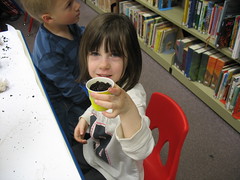
I gave each of the children a small dixie cup that they decorated on the outside. Then we filled them with damp potting soil. Then everyone got to plant either a bean or a pea. I figured those were the largest seeds with the shortest germinating time that I could think of. Plus I had some left over from my own garden last year. Yay for cheap activities! So we had the "dirt" need covered, and I did get out a plant mister and water each of their cups to fulfill the "water" need before they set their pots on the windowsill for the "sun". With the open storytimes, I had the kids take the pots home with them, but I had the daycares leave theirs here, and by the next week we had little tops peeking out, and then in two weeks, we had bean plants nearly half a foot tall! I sent the plants home at that point. A little reluctantly, since it's been fun watching this greenness growing on the desk next to me, but they're getting too big for their cups and need to be set free.
 Theme used week of March 22, 2010.

Next week: Easter is coming, with a real bunny!

Friday, March 19, 2010

Punching the clock

In honor of daylight savings starting (and to remind myself of the fact that I accidentally set my clocks the wrong way one year), we talked about time this week for storytime.  Considering that we had mostly preschoolers, I kept the minute hand at 12 and just concentrated on the hour hand.  I had a toy clock with me that we could practice with.
We started off by singing a version of this song: http://www.songsforteaching.com/jimrule/ticktocktimeclock.htm
I changed it a little by singing "Tick tock, tick tock, goes the big clock. I know the time is ___ o'clock."
We started at one o'clock (using the toy clock) and sang it through about 6 with me changing the hours each time. Since they mostly had the hang of the melody and words by that point, I asked if we could speed it up. Because really, what kid doesn't love singing faster and faster until it's almost impossible to understand the words?

Book 1: The Very Busy Spider by Eric Carle
Eric Carle does such a good job teaching concepts.  I have read The Very Busy Spider before to a storytime group, and it's a wonderful book on its own, with animals trying to talk to the spider at different times during the day.  Then I found this version that is a board book with a movable clock right in it.  Bonus!  So I was able to change the hands for every time an animal interacted with the spider and the kids could tell me what time it was.

Book 2: What Time Is It, Mr. Crocodile? by Judy Sierra
I used the Very Busy Spider clock for this book too, where Mr. Crocodile plans out his day (culminating in catching, cooking, and eating the monkeys) but is foiled by those same monkeys during each hour of the day. Naturally at the end he writes out a new plan for tomorrow which includes playing with and cooking for the monkeys.

Activity: Making clocks
The logical activity with all this would be having the kids make their own clock. Sometimes I buck the "logical" trend, but this time I just went with it. I knew I was going to be gone at a library conference for 3 of my weekly storytimes, so I wanted something not too complicated for my substitute.  Printed out this template from Enchanted Learning, and had them glue the clock to a page that said "I get up at ________ I eat lunch at ________ I go to bed at ________" Put the hands on using a paper fastener, and there you go. Simple clock craft.

Used this theme the week of March 15, 2010.

Friday, March 12, 2010

Teamwork

At storytime this week we talked about how things are easier when we all work together.  I started off by handing each child a food item - salt, pepper, carrot, onion, celery, cabbage, and chicken. As I handed them out I talked about what they were and how yummy each was (except for the salt and pepper, where we agreed that a little was good, but too much was not). Then I gave the last child a rock. You know where I'm going with this, of course...

Book 1: Stone Soup by Marcia Brown
A classic story of cooperation, where 3 soldiers trick/encourage suspicious villagers to share what little food they have by making stone soup together. This is a longer book, so I used the props I had given the children to have them come up one at a time and add them to the "soup" we were making.  I used the plastic food that I had at home, so I changed some ingredients to match what I had and skipped others entirely.  At the end, I emphasized that everyone shared and made the soup together.

Book 2: The Gigantic Turnip by Aleksei Tolstoy
A cumulative tale of a man, woman, cow, pigs, cats, hens, etc. who try their hardest to pull a gigantic turnip from the garden. In the end (of course) it only comes out when they all pull together. Again, this was a little bit wordy, but the repetition made it easier for the kids, and I tried to have them join in "...but the turnip would not come out.".  I made up flannelboard images for this story, but in the end I decided not to use them as I thought it would distract from the flow of the story.

Book 3: Sand Castle by Shannon Brenda Yee
This story of a group of kids working together to build a sand castle was going to be my shorter story that I would have read second but the library I requested it from was slow and I didn't receive it until the end of the week. I think it would have worked well enough, so maybe next time I'll request it a bit earlier!

Activity: Making a dinosaur
Before the kids came, I drew a basic Stegosaurus body minus the back plates and the legs on a large piece of paper. I drew 4 legs and enough back plates and tail spines to have enough for each kid. I had them all cut out, then passed them out and had each child decorate their own dinosaur part. We assembled the dinosaur and all decorated the body together. I tried again to emphasize that it was only by working together that we could see the complete picture.

Theme used week of March 8, 2010.

Next week we'll talk about time in honor of the start of daylight savings!

Friday, March 5, 2010

Little Pigs

National Pig Day was March 1. How can you not celebrate a holiday like that?  And there are so many good books and stories about pigs... I started off this week by pulling out my great pig puppet that I bought for my son several years ago. It's so nice and soft, and looks just like a good little piglet should. I asked if the kids had all brought their pigs too, but they all claimed they hadn't. But I proved them wrong when we all did "This Little Piggy" on our hands. Actually, for one storytime we took off our shoes and socks, but I figured it was better to stay with hands...

Book 1: Little Oink by Amy Krouse Rosenthal
A sweet story about a pig who prefers to be clean, and hates "mess up time".  The kids enjoyed the reversal in this one, where Little Oink is required to dump out all his toys and put on a stained shirt before he can go out and play.  Nice jokes in there for parents too - the pigs dig for truffles, eat from a trough at school, etc.

After Little Oink, I pulled out my pig puppet again, and added a wolf puppet, and we did the story of the Three Little Pigs.  I don't know what it is about puppets, but the kids thought this was just the greatest thing they had seen in a long time, and everyone joined in when the wolf was blowing the houses down. 

Book 2: My Lucky Day by Keiko Kasza
After nearly being eaten by a wolf, we then moved on to My Lucky Day, where our pig-hero narrowly avoids the same fate when he happens on the fox's house. But this tricky pig instead gets the fox to give him a bath, feed him dinner, give him a nice massage, and then escapes when the fox collapses, exhausted.  A little more text than a typical book I read for storytime, but with different voices and a compelling story, the kids had no problems sitting still for this one.

Book 3: Olivia by Ian Falconer
We rounded off Pig Week with one of my favorite pigs, Olivia. Just like so many of the storytime kids themselves, Olivia is an energetic pig, good at wearing people out. There are so many good Olivia stories, but I chose the original as a nice ending to a fun storytime.

Activity: This Little Piggy
This week we did just a simple coloring page of pigs, with numbers to trace. Nice & easy.  Theme done week of March 1, 2010.